
Yellow Jacket Removal
Yellow Jacket Nest Removal in Portland, Oregon, Before the Colony Hits Its Late-Summer Peak
A yellow jacket nest starts with one queen in spring and can hold thousands of workers by August. The sooner you call, the smaller and calmer the job. Same-day service across the Portland metro when my schedule allows.
- Same-day service available
- Licensed Commercial Pesticide Operator
- Quoted before any work begins
How yellow jacket removal in Portland, Oregon works, and why the date on the calendar matters
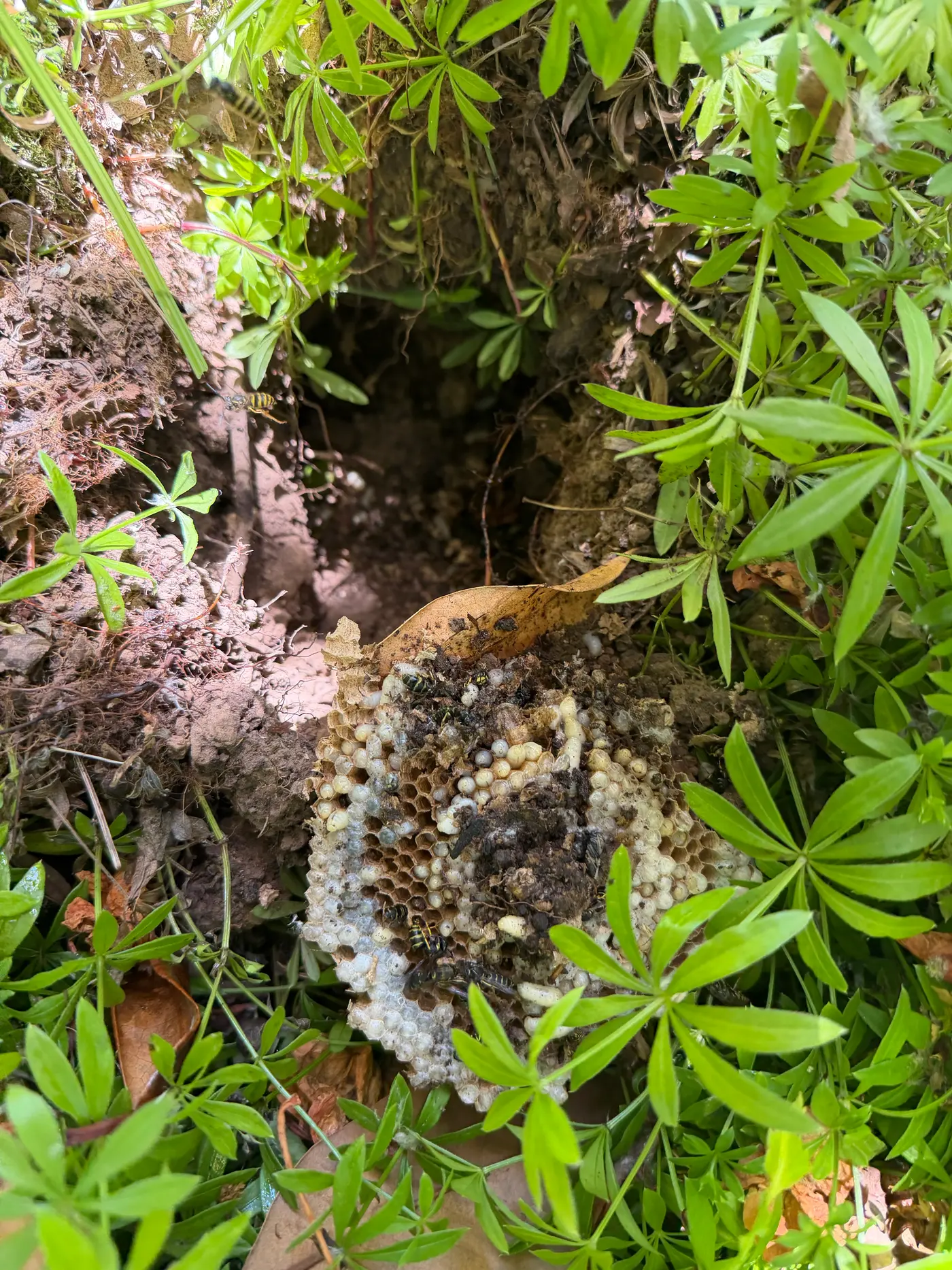
I find the opening the workers are using, treat the nest at the source, and stay until the traffic drops off. The time of year changes everything. A nest found in June holds a few dozen workers and takes minutes. The same nest in September can hold hundreds or thousands, with guards at the entrance and a much wider danger zone. Call or text (206) 817-7782 and I'll quote it before I start.
- Every nest is quoted before I begin, so you hear the price first
- Same-day service across the Portland metro when my schedule allows
- Ground nests, wall voids, attics, eaves, and ivy all handled
- Text me a photo and I'll identify it before I drive out
- Licensed Commercial Pesticide Operator, working out of West Linn, OR
Why the same yellow jacket nest is a small job in June and an emergency in September
Every yellow jacket nest in your yard started as one queen. She overwintered somewhere sheltered, came out in spring, and picked a site: an underground cavity, an opening in a building, or a protected spot outside. She built the first cells and raised the first workers herself. Once those workers emerged she stayed in the nest laying eggs, and the colony built rapidly through summer, the annual cycle Oregon State lays out in its guide to yellow jackets and honey bees.
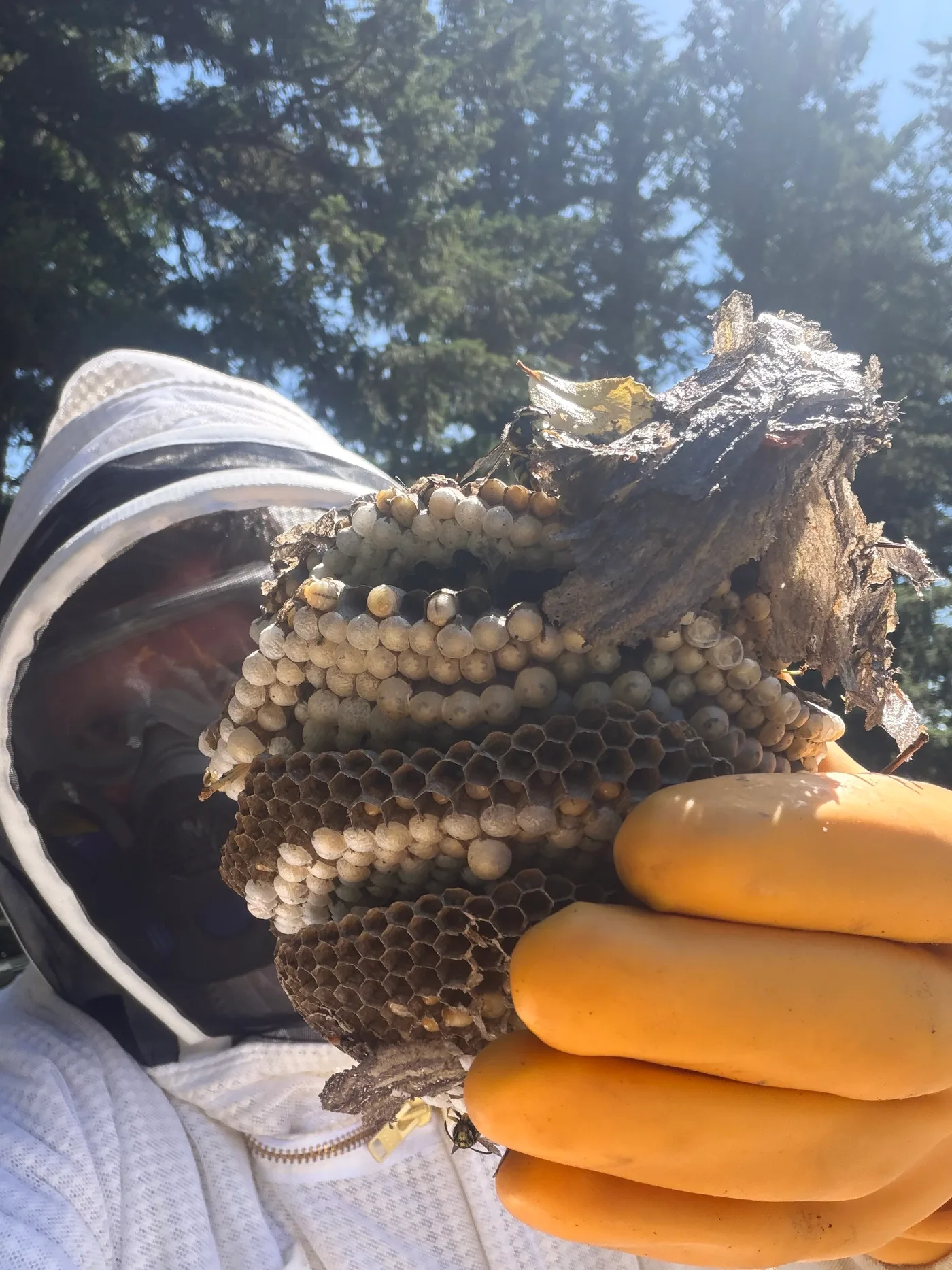
That growth compounds. More workers means more cells, and more cells means more workers. In June a ground nest is often the size of a fist with a few dozen wasps in it. By late August the same hole in the lawn can lead to a nest the size of a basketball.
Yellow Jackets aren't hunting you. They attack mainly when someone is near the nest or between them and a food source, and workers guard the nest opening. That's why the danger grows with the colony. In June, standing four feet from the hole means nothing. In September, a mower rolling past sets off hundreds of defenders.
The cheapest, calmest, safest week to handle a yellow jacket nest is the week you notice it. If you're watching a steady line of wasps going in and out of one spot in July, make the call then rather than in September. Nothing else in my wasp and hornet control work changes this fast.
The yellow jacket year in Portland, Oregon, month by month
Yellow Jacket colonies run an annual cycle, and the same nest is a different problem depending on when you catch it.
- March to April
One queen picks a site
Overwintered queens emerge and pick a nest site. There's no colony yet, just one wasp and a few paper cells.
- Favorite spots: an old rodent burrow, a gap behind the siding, a soffit corner, dense ivy
- May to June
The first workers take over
Once the first workers emerge, the queen stays in the nest and lays eggs from then on.
- The colony is small and quiet, and a nest this early is a genuinely minor job
- Almost nobody notices one, which is exactly why September gets busy
- July
The nest doubles, then doubles again
Traffic at the entrance gets obvious: a steady line of wasps at one spot in the lawn or one gap in the siding.
- The last easy month. A July removal saves you the September version of the same problem
- August to September
Peak numbers, and the food raids start
The colony peaks just as its insect prey thins out, so workers get bold around barbecues, garbage cans, fruit trees, and open cans of soda.
- The queen is laying the eggs that become next year's queens
- The nest is at its largest and best defended in the same weeks your yard gets the most use
- October to November
The cold ends the colony
Hard frosts finish the workers and the old queen, but the weeks leading up to that aren't quiet.
- As adults begin to die off, Oregon State warns yellow jackets can turn aggressive and sting unprovoked
- Once the cold has done its work the nest is abandoned, and one nobody walks past can simply be left alone
Where yellow jackets nest around Portland, Oregon homes, and where they turn up hunting for food
Yellow Jackets nest in cavities, so the nest stays hidden and the entrance is the only clue you get.
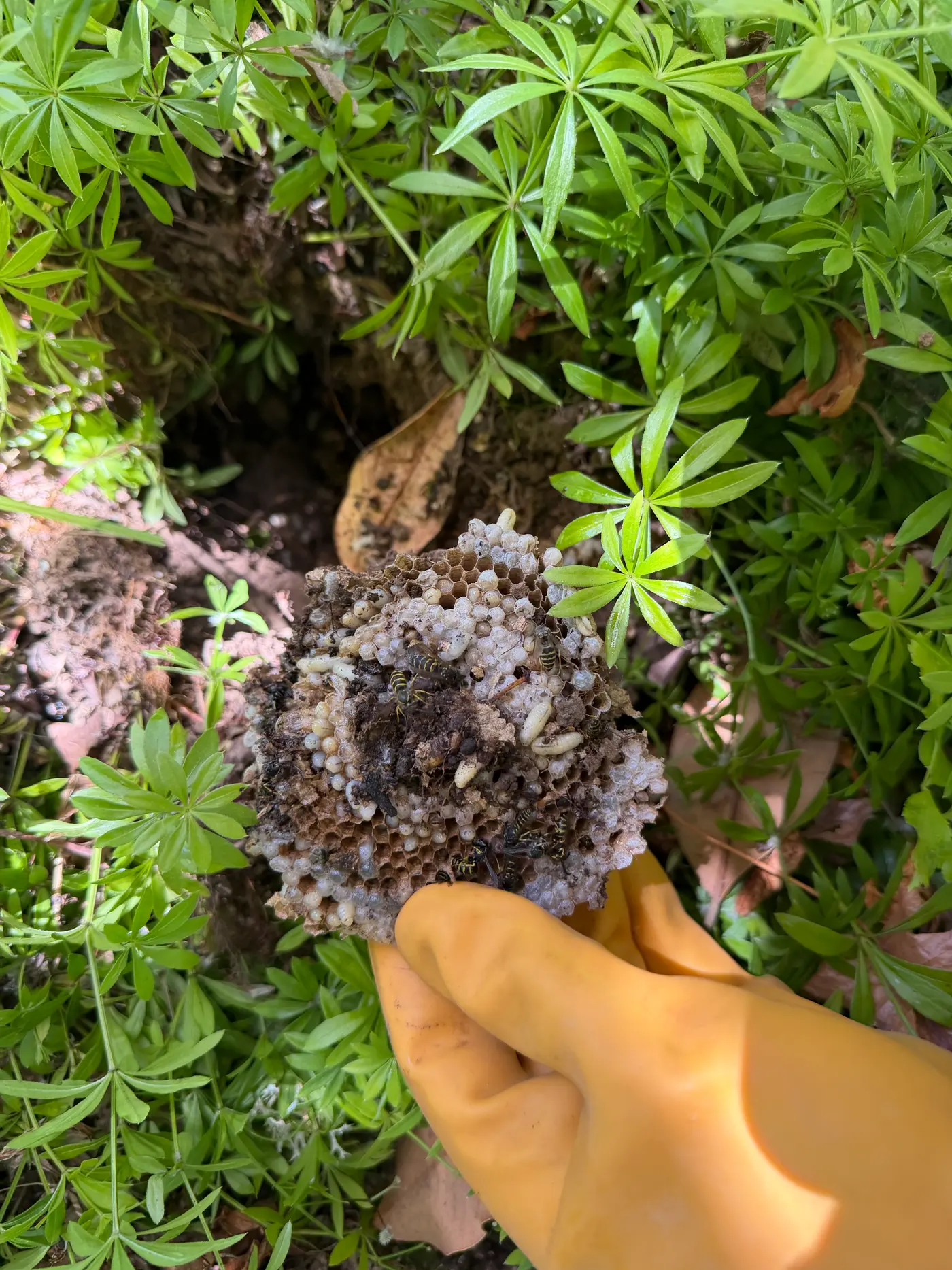
Ground nests in lawns, banks, and old rodent burrows
A hole in the turf with wasps streaming in and out is the classic ground nest, and it's the one that hurts people. A mower or a string trimmer passing over the entrance starts most of my late-summer sting calls. The mower never has to touch the nest. The vibration is enough. My Richmond ground nest job shows an opening among ferns and rocks. I removed two nests on that visit.
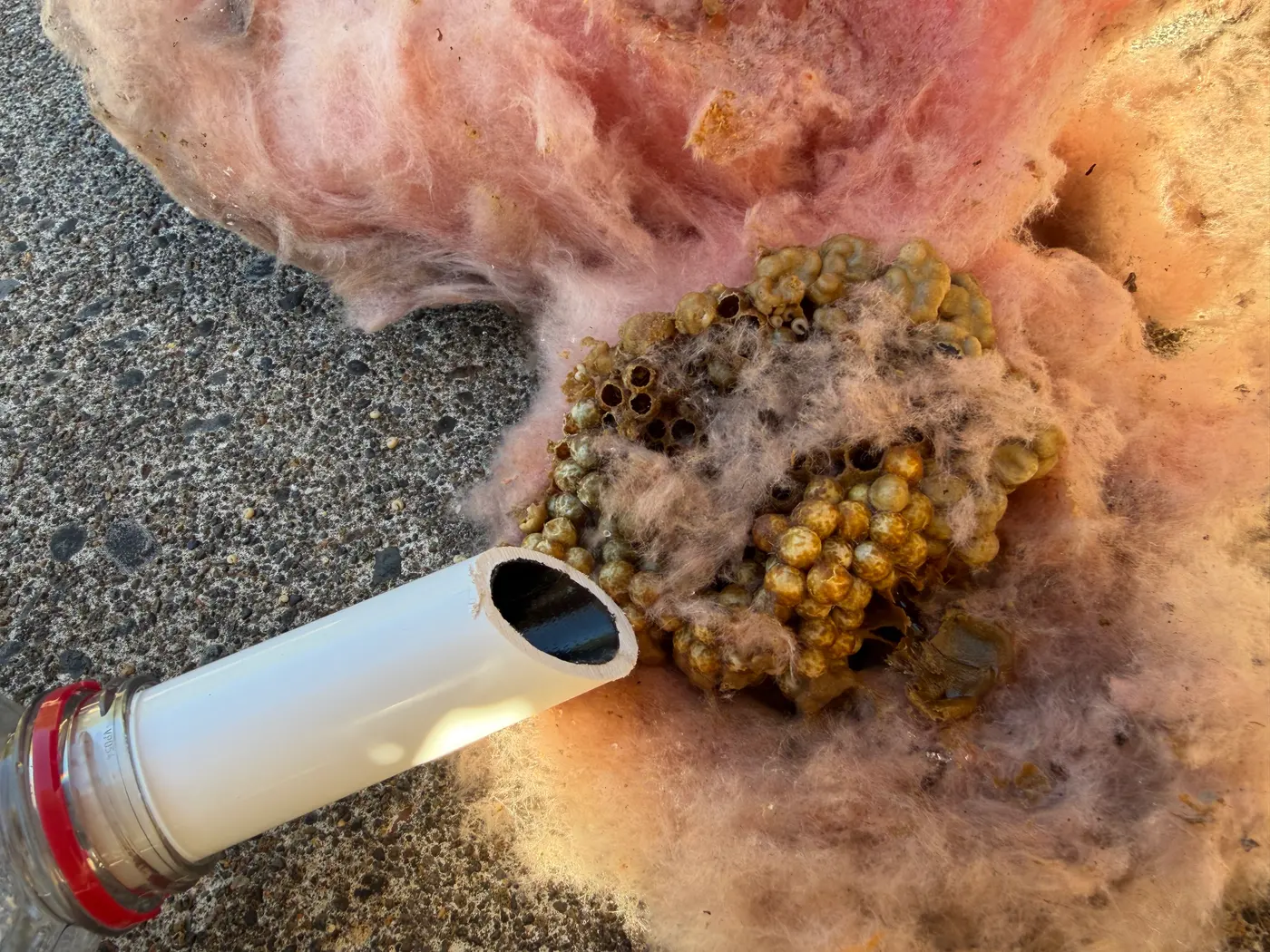
Wall voids, soffits, and attic corners
A gap behind the siding, a torn vent screen, a weep hole, a cable entry. The colony sets up inside the void and you only see the entrance. Sealing that opening on a live colony pushes the wasps to chew toward the quiet side, which is your living room.
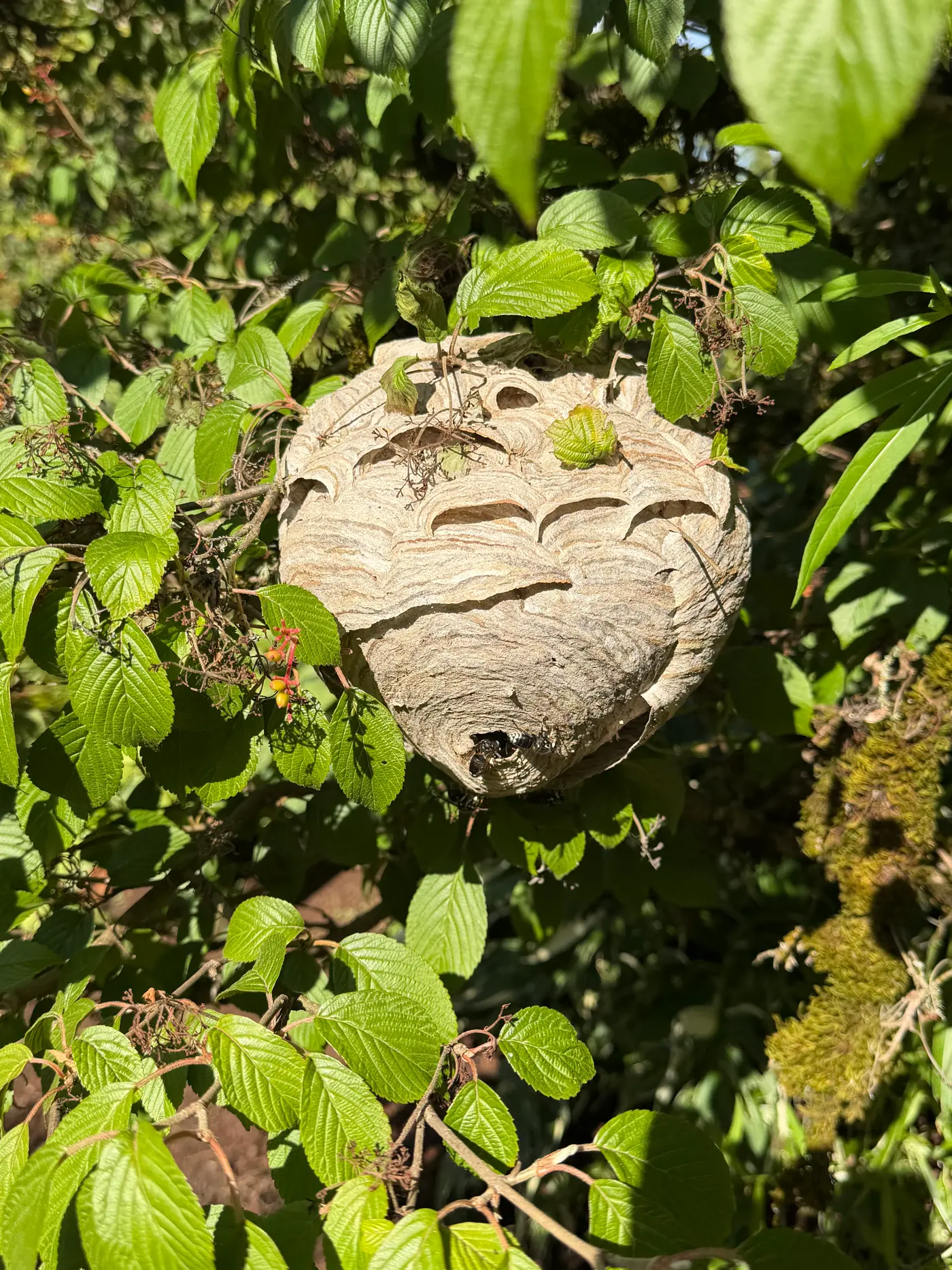
Eaves, sheds, dense ivy, and rockeries
Some yellow jacket relatives build out in the open. The big gray paper ball on a branch or an eave belongs to the bald-faced hornet, an aerial yellow jacket, so that's hornet nest removal. An open umbrella of visible cells under a porch ceiling is paper wasp work. The nest shape tells me which before I load the truck.
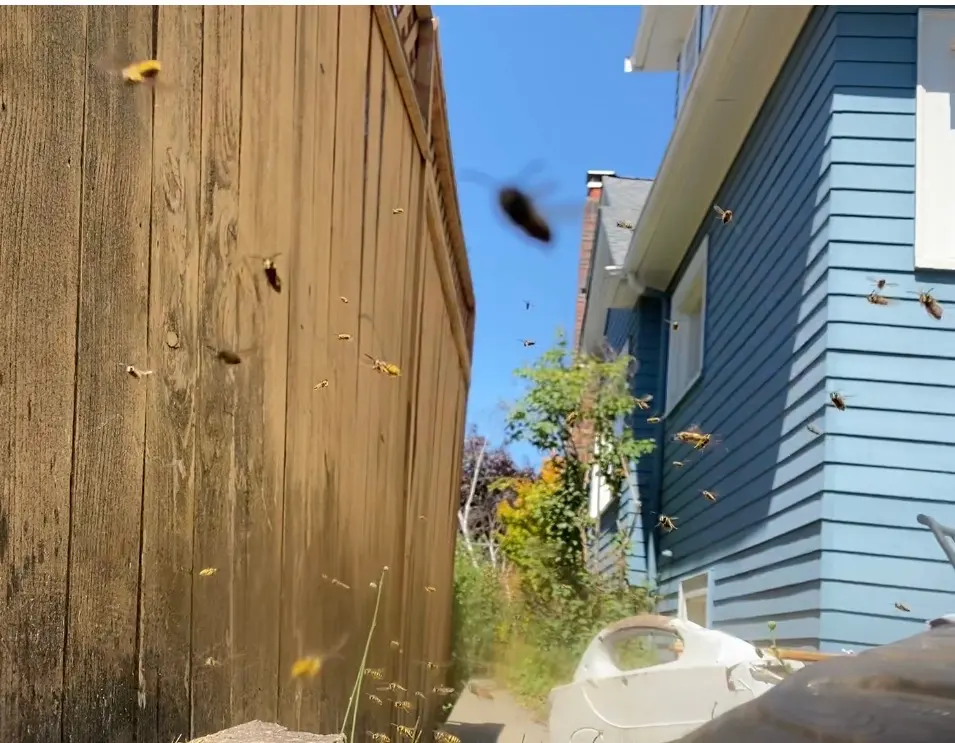
Trash cans, fruit trees, and the picnic table
By August the foragers want sugar and protein wherever they find it: recycling bins, fallen plums, pet food, your lunch. They raid honey bee hives this time of year too, which is why beekeepers keep an eye on them. Wasps at the table don't always mean a nest in your yard.
What to do when yellow jackets are flying out of a hole in your lawn
The ground nest in the lawn is the call I get most, and it's where a few minutes of caution matter most.
Do this
- Mark the spot from a distance. A lawn chair set back ten feet works as a warning.
- Keep kids, dogs, and the mower off that part of the yard until it's handled.
- Watch the traffic from well back so you can tell me which opening they're using.
- Use your phone's zoom for the photo instead of walking in close.
- If someone swells beyond the sting site or has trouble breathing, call 911 first and me second.
Please don't
- Don't pour gasoline, bleach, or boiling water into the hole. It contaminates your soil and rarely reaches the comb.
- Don't plug the entrance and walk away. They chew a new one, and in a wall that can open on the inside.
- Don't mow, edge, or run the trimmer near the opening until the nest is finished.
- Don't spray from a foot away. Close enough to be accurate is close enough to be stung.
- Don't swat one that lands on you. Brushing it off calmly is less likely to end in a sting.
How a yellow jacket nest removal goes when I come out
I work alone, so the person on the phone, in your yard, and explaining it afterward is the same person. This is the order it happens in.
- 1
You call or text me a photo or a video
Send a photo or a short video of the insect or the entrance to (206) 817-7782, or just call and describe it. A few seconds of video of the traffic at the hole tells me more than a still does.
- 2
I identify it before I leave
I name the species from what you send me, before I get in the truck. That's the whole point of the photo: a yellow jacket, a paper wasp, and a bumble bee are three different jobs, and I'd rather turn up with the right gear than work it out in your driveway.
- 3
I quote the job before any work begins
You hear the price and agree to it before anything gets treated. Nothing starts on a maybe. If you want the ants or the spiders looked at while I'm there, say so, because booking several services together brings the rate down.
- 4
I find the opening they're actually using
The hole you noticed isn't always the live one, and a nest in a wall can enter at one point and exit at another. I watch the flight lines first, because treating the wrong gap leaves the colony intact.
- 5
The nest gets destroyed at the source
I treat the nest at the entrance, in full gear, so the colony carries it back rather than getting sprayed across your yard. With yellow jackets the nest is nearly always inside a cavity, so this is the honest expectation: the colony doesn't get moved, it gets finished.
- 6
I check the traffic and tell you what to expect
Foragers that were out during treatment come back for a while, so a few stragglers the next day are normal. Where the comb is reachable I take it out, and I point out the gap that let them in.
What yellow jacket nest removal costs around Portland, Oregon, and how to get your number today
No flat rate, and I am not going to put a number on a page and then change it in your driveway. Every nest is quoted before I start, and a photo of the entrance is usually enough for me to price it before I even drive out. Where yours lands comes down to these four things, and the growth curve shows up in the price too.
Pricing
You get a quote before any work begins
Call or message me for a quote. Send a photo to (206) 817-7782 and I can usually price it without a visit.
Call or text (206) 817-7782Where the nest is
An open lawn nest I can walk up to is the simplest version of this job. A nest twenty feet up under a soffit, behind a rockery, or deep in ivy takes longer and takes more equipment.
How far the colony has grown
A June nest with a few dozen workers and a September nest with hundreds aren't the same job, even in the same hole. Bigger colonies need more time and a wider work area to stand in.
How much you want handled at once
Booking several services together brings the rate down. My annual Complete Insect Protection plan runs quarterly visits with free priority emergency visits in between, and is offered to West Linn, Lake Oswego and Oregon City clients only.
Whether anything has to come apart to reach it
A nest I can treat at the entrance is one price. One where a vent cover, a soffit board, or a run of siding has to come off before I can get at the comb takes longer, and it carries the putting-back-together with it.
If I get out there and your nest doesn't need treating, I'll tell you that instead of selling you something.
Text me a photo before you book anything
I'd rather spend two minutes on a photo than have you pay for the wrong service. Send a clear shot of the insect or the opening to (206) 817-7782 and I'll tell you what you're looking at. If it turns out to be honey bees or bumble bees, that's a different job entirely, and one where I try to save the colony rather than treat it. Honey Bee removal and relocation is the work I got into this for.
Google reviews
What Portland, Oregon homeowners say after the job
5.0 from 25 Google reviews
Read them on GoogleSam came out the day after I called and had predicted the situation correctly when we chatted on the phone. He was able to get rid of the yellow jackets and even helped with an ant issue we had. Super nice and knowledgeable!
Erin Dhruva Great service, fast response!
Alex Ramberg Sam was great. He was able to come out same day and take care of the yellow jackets living in our siding. He's efficient and professional. Highly recommend!
Susan Thomsen Before calling Sam, I was told by a “professional” Pest service that the infiltrators getting through my siding were honeybees. The bees were quite visible through my window, but we’re misidentified. Fortunately, I called Sam and he corr...
Patty Rissberger I called Sam to help with a yellow jacket hive in an exterior wall of my house. He communicated quickly over text, made an appointment for the same day, arrived when he said he would, and answered all of the questions I had. He treated t...
Sarah H Sam was great. He ended up coming the same day and removing a yellow jacket nest for us. I would highly recommend him to anyone!!
Tori Phillps From start to finish Sam was professional and easy to work with, he was knowledgeable and friendly and well prepared! It was a much more enjoyable experience to work with Sam than calling a big named exterminator. Sam was honest and fair...
Tamsyn Cox Sam was great! Successful wasp removal, easy communication, quick work. Would call again if needed.
Jen P Sam was outstanding to work with! We had a huge hive return to a spot in our attic that had been previously cleared a year earlier. I called Sam on a Tuesday and he came out the next morning! He worked quickly and efficiently to remove t...
Brian Odell I called Sam and was on a job and about done for the day and I explained my situation and he went out of his way and gave me a time he would be here and he was right on time. Did a Sunday removal of a wasps nest on my front porch and onc...
Michael puderbaugh Called Sam and he answered right away. He was able to come out within a few hours and took care of a large yellow jacket nest that had been built in a fern bush next to my driveway where we walk to get into the back gate and garage. He w...
Diana Lu Sam arrived quickly, day of, to save us from an aggressive hornets nest. Sam knew exactly the hornet before even having eyes on it and was communicative and helpful. The experience was much easier than trying to deal with some others in...
Katheryn Hayward We discovered a wasp nest in a planter in our back yard yesterday (and got stung 3 times, ouch!) and called Sam this morning. He was able to come out a few hours later and eradicate the nest. He was thoughtful, knowledgeable, and just a...
Hans Nolf Sam was awesome! Our Tennant texted us late Sunday night stating her heard buzzing in the walls, and Sam was able to come take a look the next day! He is clearly very knowledgeable and gave us quite a bit of information. Extremely kind a...
Megan Delmore Sam was super friendly and worked very efficiently to remove a huge colony of yellow jackets from our soffit…..which was 16 feet off the ground! Recommend very highly, worth every penny!
Laurie Kunert Fantastic service, Timely, Professional, Friendly, Easy to work with, Great value for the price, Good communication. Bye bye yellow jackets!
Scott Klees I had an urgent need at my work location. I texted Sam at 3:30pm. He replied within the hour. We made a plan for meeting to survey and treat the situation. He was on site by 6:15 and done working by 7:00pm. 5 stars for communication, for...
Patrick Clark A+++++! We were so relieved to find Sam the Bee Man! After an unsuccessful removal by a different bee pro, we were feeling helpless until I found Sam. Not all bee experts have the skill to cut into a structure, but Sam does. He used a he...
Jennifer Stafford Professional and friendly to work with. Great communicator and very knowledgeable. Would strongly recommend for any pest control or be removal services. If you have a wasp, they also specialize in that.
Detail Maestro Sam came out the same day I contacted him, and was able to quickly find and remove a yellow jacket nest. He also was able to talk to me about options for treating ants in my backyard, offering varying levels of treatment that felt most...
Ali C I had a bee problem. I messaged Sam this morning at 8:30am. He responded by 8:46am and was at my building by 1pm. Sam is highly knowledgeable and extremely thoughtful. His approach to bee management is taking into account the safety of t...
Nadine Stanton Sam is so knowledgable and is a godsend to us for keeping the ants and spiders away in our home. His membership model is super valuable and reasonably priced and perfect for our needs. He's also just super friendly and takes his time to...
Veronica McOmie Sam's my new pest control go to man. I had a HUGE ant issue in the primary bathroom. Sam came out the same day I called. He assessed the situation, determined the entry point and provided options for getting rid of them. I have signed...
M R Sam was great. When I had a bumble bee hive in my garage, he came out the same day and was able to relocate the hive to a safer location.
ryan spooner Great experience with Sam the Bee Man! Professional and thorough. Highly recommend!
Jessica Reed
Call or Text (206) 817-7782
For the quickest response to your bee, wasp, or pest concern.
Common questions
Yellow Jacket removal in Portland, Oregon, common questions
Yellow Jackets are coming out of a hole in my yard. Is that a nest?
Almost certainly. Ground nests in old rodent burrows are one of their favorite spots, and mowing over one is how a lot of people around here get stung. Mark the area from a distance, keep kids and pets off that part of the yard, and call or text me.
How much does yellow jacket removal cost in Portland?
Call or message me and I will quote it. The price depends on where the nest is, how far the colony has grown, and whether anything has to be opened up to reach it. A lawn nest I can walk right up to sits at the low end. You get the number before I start.
How fast can you get out to a yellow jacket nest?
Often the same day. I offer same-day service throughout the Portland metro when my schedule allows, and an active nest by a doorway or a play area is the kind of call I move to the front. Text me your address and a photo and I'll tell you where I can fit you in.
Why are yellow jackets so aggressive in late summer?
Two things line up at once. The colony reaches its largest size right as its natural insect prey gets scarce, so more workers are out hunting for food in more places. At the same time the nest has more defenders at the entrance than at any other point in the year.
Do yellow jackets come back to the same nest every year?
No. The colony dies off with the cold and the nest is never reused. Next year's queens overwinter somewhere else and start fresh in spring. A spot that suited them once will suit them again, so I point out the burrow or the gap that attracted them and you can close it.
Do I need a yellow jacket exterminator, or will the nest die off on its own?
It depends on where the nest is and what month it is. One that nobody walks past, found in late October, dies with the first hard frosts anyway. One by your back door in July only gets bigger for two more months. Send me a photo and I'll give you the honest answer, even when the answer is that you can wait.
How do I tell a yellow jacket from a honey bee or a bumble bee?
Yellow Jackets are smooth and shiny with bright yellow and black bands, a pinched waist, and legs held tight to the body in flight. Honey bees are fuzzier and more golden brown, and in season they carry packed pollen on their back legs. Bumble bees are big, round, and very furry. If an insect lands on you and wanders around calmly, it's almost never a yellow jacket.
Can you get rid of a yellow jacket nest without pesticides?
Rarely, and I'd rather be straight with you than sell the idea. Yellow Jackets nest in cavities, so the colony is almost always somewhere I cannot lift out, and a product at the entrance is what finishes it. Where a nest happens to sit somewhere reachable I'll take it off whole. Ask when you call and I'll tell you which one yours is.
Request a quote
Step 1 of 1